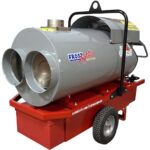
Ensure warmth and comfort at your outdoor event with our 85,000 BTU Tent Heater. Designed to provide powerful heating in large tented spaces, this heater keeps guests cozy and comfortable, even in chilly weather conditions.
Absolutely! A 50% non-refundable down payment is required to reserve an item for you. This pulls the item out of our inventory and sets aside your delivery time in our schedule for the installation if it does move forward. You may cancel the tent before 12pm on the 5th business day before the delivery date. If you decide to move forward with the tent, the down payment would apply to the balance due.
We always try to accommodate last-minute requests, but during peak times this may be not possible. Reserving your tent in advance ensures that both inventory and delivery slots are set aside for you.
Our standard rental timeframe is approximately 3 or 4 days depending on the day of the event (delivery the business day before the event, pick up the business day after the event). We also offer long-term rental options for needs such as construction, renovation, natural disasters, etc.
The balance is due 5 business days before delivery. If payment is not received, we will try to reach you to secure payment so the reservation goes forward. T3 reserves the right to cancel the reservation if we do not receive payment.
A clearspan tent is a heavy-duty, engineered structure built with an aluminum frame and modular design. Unlike traditional frame tents, clearspan tents have no center poles or guy lines, offering a completely open interior space. They are designed to handle larger loads, longer spans, and more extreme weather conditions. Clearspan tents are commonly used for weddings, festivals, corporate events, and even temporary warehouses where strength, durability, and clear open space are essential.
Your irrigation lines must be marked before we arrive on site. You can call 811 for a free locate service of the major utility companies. They will only mark from the main line to the meter so it is your responsibility to know where lines run on your property. Most of the time we can avoid them if we know where they are.
To provide the best experiences, we use technologies like cookies to store and/or access device information. Consenting to these technologies will allow us to process data such as browsing behavior or unique IDs on this site. Not consenting or withdrawing consent, may adversely affect certain features and functions.
Functional
Always active
The technical storage or access is strictly necessary for the legitimate purpose of enabling the use of a specific service explicitly requested by the subscriber or user, or for the sole purpose of carrying out the transmission of a communication over an electronic communications network.
Preferences
The technical storage or access is necessary for the legitimate purpose of storing preferences that are not requested by the subscriber or user.
Statistics
The technical storage or access that is used exclusively for statistical purposes.The technical storage or access that is used exclusively for anonymous statistical purposes. Without a subpoena, voluntary compliance on the part of your Internet Service Provider, or additional records from a third party, information stored or retrieved for this purpose alone cannot usually be used to identify you.
Marketing
The technical storage or access is required to create user profiles to send advertising, or to track the user on a website or across several websites for similar marketing purposes.